


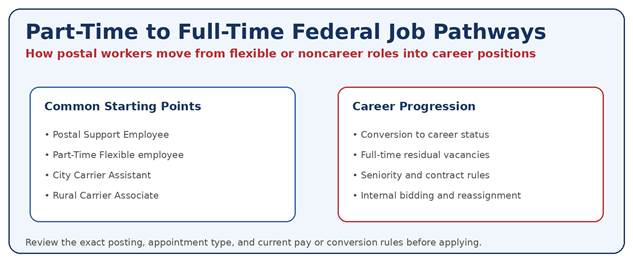
Can a Part-Time Postal Job Lead to Full-Time Career Employment?
Yes. USPS uses several employee classifications that create pathways from flexible or noncareer work into career positions. The path is not identical across crafts. Some employees convert automatically after a defined period, while others convert when career vacancies become available under collective bargaining rules.
A key distinction is that part-time does not always mean noncareer. USPS part-time flexible employees are career employees who work flexible schedules. By contrast, Postal Support Employees and City Carrier Assistants are examples of noncareer or pre-career classifications that may convert later.
Understanding the Main USPS Employment Categories
|
Classification |
Career Status |
Typical Path |
|
Full-Time Regular |
Career |
Assigned a regular full-time schedule |
|
Part-Time Flexible |
Career |
Works flexible hours and may move into full-time regular vacancies |
|
Part-Time Regular |
Career |
Works a regular schedule below 40 hours |
|
Postal Support Employee |
Noncareer |
Many PSEs convert to career after 24 months if not converted earlier |
|
City Carrier Assistant |
Pre-career |
May convert to career under city carrier contract rules |
Postal Support Employee to Career Status
Under the APWU 2024-2027 agreement, most Postal Support Employees continue to receive automatic conversion to career status after 24 months of relative standing if they have not converted earlier. The major exception is certain four-hour Remotely Managed Post Office PSE positions. Earlier conversion may occur when residual career vacancies become available.
Depending on office level and craft rules, a converted employee may become part-time flexible or full-time flexible before later moving to a full-time regular assignment. Conversion changes the employee into career status and opens access to the broader career benefit and retirement structure.
Part-Time Flexible to Full-Time Regular
Part-Time Flexible employees are already career workers. USPS rules state that qualified PTF employees may be converted to full-time positions when appropriate residual vacancies exist, after higher-priority full-time assignments are handled and subject to the applicable collective bargaining agreement. A PTF moving to a full-time position in the same grade generally keeps the pay step already earned.
Applicants exploring USPS jobs should check whether a posting says career, PTF, noncareer, seasonal, or temporary. Those labels matter more than the casual phrase “part time.”
City Carrier Assistant Pathway
City Carrier Assistants work in the letter carrier craft and may move into career carrier positions through conversion rules in the NALC agreement. Full-time regular opportunities are filled according to contract procedures, including conversion of eligible CCAs and placement of existing career employees. The timing depends on vacancies, installation size, relative standing, and contract limits on transfers.
Why Career Conversion Matters
- Eligibility for FERS retirement benefits in covered career positions
- Access to the Thrift Savings Plan with applicable USPS contributions
- Postal Service Health Benefits eligibility under career rules
- Career leave accrual and stronger job-security provisions
- Formal step progression and access to internal bidding
- Greater opportunity for transfer and advancement
Part-Time Does Not Always Mean Fewer Long-Term Options
A PTF schedule may vary from week to week, but the employee is already in the career workforce. This makes PTF work different from many private-sector part-time jobs that have no formal conversion route. The tradeoff is schedule uncertainty. PTF employees often need broad availability and may work weekends, holidays, or changing tours.
Use Current Openings to compare job type, hours, and location, then verify the appointment status in the full posting before assuming a role leads directly to full-time regular work.
How Long Does Conversion Take?
There is no universal timeline. APWU PSEs generally have a 24-month automatic conversion rule unless they fall into an excluded category or convert earlier. PTF employees may move to full-time regular when residual vacancies become available. Carrier conversions depend on carrier-specific contract rules and local vacancies. Some employees move quickly in high-turnover offices, while others wait longer.
How to Choose a Good Pathway Job
- Look for the words career, PTF, PSE, CCA, RCA, or full-time regular in the posting.
- Ask whether the role has an automatic conversion provision.
- Check whether seniority or relative standing controls conversion order.
- Compare the benefit package before and after conversion.
- Review the schedule expectations and overtime requirements.
- Do not assume every federal-style or postal listing has the same conversion rules.
External Career-Path Reference
The APWU summary of the 2024-2027 agreement explains the current PSE automatic conversion and career-opportunity provisions, including the 24-month rule for most PSEs and the distinction between career and noncareer positions.
Frequently Asked Questions
Is a USPS part-time job a federal career job?
Sometimes. Part-Time Flexible and Part-Time Regular employees are career employees, while classifications such as PSE or CCA are pre-career or noncareer.
Do PSEs automatically become career employees?
Most PSEs covered by the APWU conversion provision convert after 24 months of relative standing if they have not converted earlier. Certain RMPO positions are excluded.
Does career status mean full-time?
No. A worker may be a career Part-Time Flexible employee and later move into a full-time regular assignment.
Will a PTF keep the same pay step after moving full-time?
USPS pay rules generally treat a same-grade change from part-time to full-time as a reassignment, so the employee retains the step attained.
Can conversion happen before 24 months?
Yes. Vacancies and craft-specific rules may allow earlier conversion.
Is a pathway guaranteed when I apply?
No. Read the current collective bargaining rules and the specific vacancy. Conversion depends on classification, vacancies, eligibility, and contract provisions.
Final Takeaway
USPS offers several structured routes from flexible or noncareer work into career employment. The strongest pathway depends on the craft. PSEs have a defined 24-month conversion rule in most covered offices, PTFs are already career employees, and carrier conversions follow separate vacancy and seniority rules. Read the appointment type before treating any part-time listing as either temporary or permanent.
