


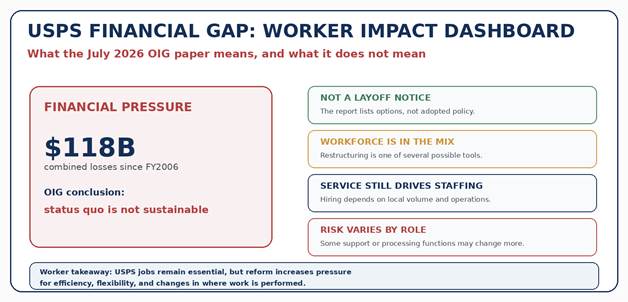
The Report Is Serious, but It Is Not a Layoff Announcement
On July 22, 2026, the USPS Office of Inspector General released a white paper titled Options for Addressing the U.S. Postal Service’s Financial Gap. Its warning is severe: USPS has recorded annual losses since fiscal year 2006, with combined losses approaching $118 billion. The OIG said maintaining the status quo is no longer a viable path.
For workers, the important distinction is that the paper does not announce a reduction-in-force, facility closure plan, or adopted workforce restructuring program. It compiles 15 policy options discussed by different stakeholders and groups them into possible scenarios. Workforce restructuring is one option among several, alongside revenue growth, government funding, benefits reform, pricing changes, outsourcing, and service changes.
Why the Financial Gap Matters to Employees
USPS is expected to finance its operations primarily through postal products and services. Persistent losses create pressure on cash, borrowing capacity, investment, benefits funding, service standards, and labor costs. Because labor represents the largest share of postal expenses, workforce policy inevitably becomes part of any serious financial discussion.
Front-line work remains necessary because USPS must collect, process, transport, and deliver nationwide. Financial pressure instead increases scrutiny of how much labor is needed, where it is needed, and how work is organized.
What the OIG Actually Put on the Table
The OIG organized the options around five broad goals: growing operating revenue, obtaining government funding, making workforce changes, reforming benefits, and reducing operating costs. Under the workforce category, the paper discusses ideas such as changing workers’ compensation rules, restructuring the workforce, and examining collective bargaining rules.
Under cost reduction, it also includes options such as outsourcing the middle mile, outsourcing the retail network, converting more door delivery to curbside or cluster boxes, reducing delivery days, and stopping selected universal-service activities. These are policy scenarios, not approved actions, but they show where pressure could emerge if finances worsen.
Which Jobs Look More Secure?
The strongest job security generally sits closest to essential daily operations. Carriers, maintenance employees, vehicle technicians, processing employees, transportation roles, and service-continuity positions remain central to the network.
Security is never absolute. Network modernization can move processing work between facilities, automation can change staffing levels, and route or retail redesign can alter assignments. Still, universal service requires a nationwide workforce, so the financial gap is more likely to change the mix and location of jobs than eliminate the need for postal labor altogether.
Where Workers May See More Change
- Facilities where processing functions are being consolidated or redesigned.
- Support functions that can be centralized, automated, or reduced.
- Work that overlaps with possible outsourcing proposals.
- Locations with persistent low productivity, excess work hours, or underused capacity.
- Roles affected by changes in delivery frequency, retail strategy, or transportation design.
What the September Workforce Data Adds
Later 2026 OIG and USPS workforce reporting adds useful context. USPS remains a very large employer, with roughly 624,000 employees in the latest full official workforce count. The organization has also converted tens of thousands of pre-career employees to career status in recent years, even while overall headcount has declined.
USPS is not simply eliminating workers across the board. It is stabilizing parts of the workforce while reducing costs and matching staffing more closely to demand.
What Job Seekers Should Take From the Report
|
Question |
Best Reading of the Evidence |
Applicant Response |
|
Are USPS jobs disappearing? |
No. Essential operations still require a large workforce. |
Keep app to real vacancies |
|
Will every facility stay the same? |
No. Network and facility changes will continue. |
Research the specific location |
|
Are benefits and workforce rules under pressure? |
Yes. Reform is part of the financial debate. |
Read appointment type carefully |
|
Are frontline roles risk-free? |
No, but core operational work remains necessary. |
Favor transferable operational skills |
USPS Jobs Are Secure in a Different Sense Than Private Jobs
USPS cannot simply leave unprofitable markets because its universal-service mission requires national coverage and regular delivery. That supports long-term demand for postal workers, even as USPS reorganizes facilities, changes schedules, automates tasks, or outsources selected functions.
The result is a form of structural job stability with ongoing role risk. Postal work remains necessary, but the exact job, location, shift, or career path can change.
How to Protect Your Career Position
- Build skills that transfer across delivery, processing, maintenance, transportation, or customer operations.
- Stay reliable on attendance and safety, since low-performing facilities face heavier scrutiny.
- Learn new equipment and digital systems as the network modernizes.
- Watch local facility reviews and operational announcements.
- Understand whether your role is career, pre-career, temporary, or contract-based.
Finding Current Opportunities
Applicants can compare current USPS JOBS across delivery, processing, logistics, and support categories. The financial report should not stop qualified applicants from app; it should encourage them to examine the specific role and location more carefully.
What About Postmaster and Management Roles?
Management positions are also affected by the push for efficiency, service improvement, and stronger financial accountability. Postmasters and supervisors remain important, but leadership roles may face restructuring as USPS looks to simplify decision-making, improve local performance, and reduce unnecessary overhead.
If you are exploring usps postmaster jobs, expect stronger emphasis on service metrics, workforce management, customer responsiveness, and operating discipline.
External Reference
The primary source is the USPS Office of Inspector General’s July 22, 2026 white paper, Options for Addressing the U.S. Postal Service’s Financial Gap. The paper explains the 15 options and makes clear that they are proposals assembled for discussion rather than adopted OIG recommendations.
Frequently Asked Questions
Does the July 2026 OIG report announce USPS layoffs?
No. It presents policy options and theoretical scenarios. It does not announce a reduction-in-force or a confirmed workforce restructuring plan.
Why does the report mention workforce restructuring?
Labor is the largest USPS expense, so any serious financial solution has to consider staffing, compensation, productivity, or work design.
Are carrier jobs still needed?
Yes. USPS must continue nationwide collection and delivery, although route structures, schedules, and staffing levels can change.
Could processing jobs move between facilities?
Yes. Network modernization and facility reviews can shift processing functions and therefore change where some jobs are located.
Should the report stop me from app to USPS?
No. Current vacancies represent real staffing needs. Applicants should focus on the specific role, facility, appointment type, and long-term path.
Final Takeaway
USPS jobs are not risk-free, but the July 2026 OIG report does not mean the Postal Service is preparing to eliminate its workforce. The real message is that financial pressure will force harder choices about staffing, benefits, service, facilities, and operating costs. Workers closest to essential service remain important, while roles and locations may continue to change. For applicants, USPS still offers meaningful career opportunities, but long-term security increasingly depends on flexibility, transferable skills, and where the network is headed.
